
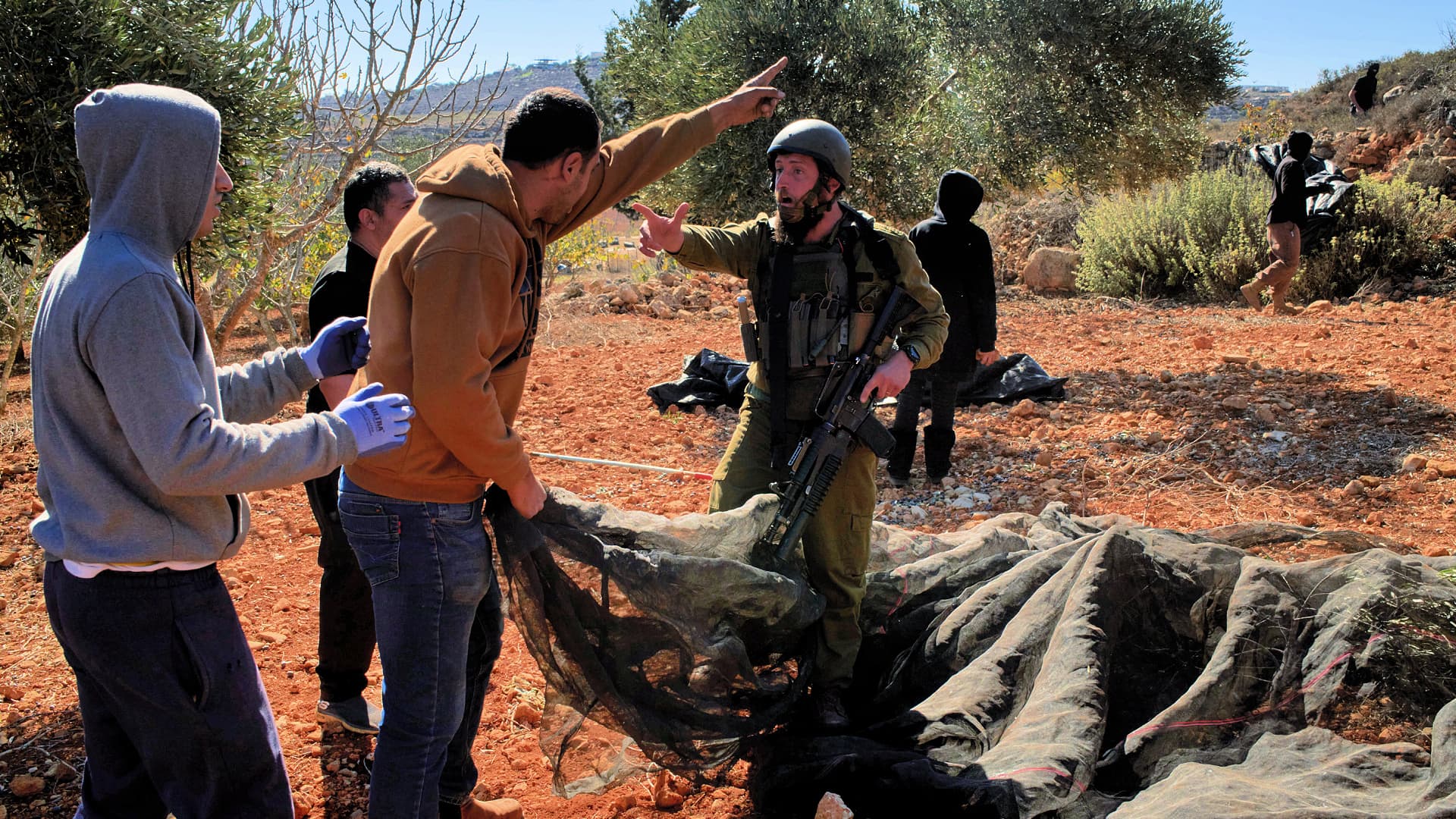
The Palestinian Farmers Union estimates that 55 percent of the olive crop remained inaccessible or unharvested by late October, threatening livelihoods across the West Bank.
“Since October 7, I have not been able to set foot in my olive grove,” Abbas Milhem, executive director of the Palestinian Farmers Union (PFU), told Olive Oil Times.
Milhem’s land lies in Area B of the occupied West Bank. Under the Oslo Accords, Area A is under Palestinian civil and security control, Area B under Palestinian civil administration with Israel retaining security responsibilities, while Area C remains under full Israeli civil and security control.
According to Milhem, experiences like his are increasingly common for Palestinian olive growers across the West Bank.
PFU estimates that about 140,000 Palestinian families depend entirely or partly on the olive sector, including around 100,000 who own olive groves and another 40,000 who rely on seasonal harvesting work.
“Roughly 700,000 people derive at least part of their livelihood from olive growing and olive oil production,” Milhem said.
According to the United Nations Office for the Coordination of Humanitarian Affairs (OCHA), 199 olive harvest-related settler attacks were documented between September 1 and October 12. The incidents resulted in one Palestinian fatality, 124 injuries and damage to more than 2,500 trees and saplings.
PFU, using a broader definition, said it documented 1,910 attacks and violations during October, including theft, physical attacks and vandalism. It reported four Palestinians killed, more than 140 injured, 7,346 olive trees damaged and more than 50 tonnes of olives stolen.
In a report shared with Olive Oil Times, PFU counted not only physical attacks and property damage as violations but also incidents in which farmers were prevented from reaching their groves.
“If settlers in a village blocked the road, prevented the farmers from reaching their area, their grove, for us, this is a violation documented,” Milhem said.
The union said it collected its figures through a field network established ahead of the olive harvest. Together with the United Nations Food Security Sector and other organizations, PFU identified 178 villages with high-risk areas, organized assistance in 104 of them, and deployed 208 field workers to accompany farmers, provide equipment, and document incidents.
By the end of October, PFU estimated that 55 percent of the olive crop remained inaccessible or unharvested, particularly in high-risk areas.
Based on its assessment of conditions during the harvest, the union projected Palestinian olive oil production at 10,000 to 11,000 tonnes, about half its initial estimate of 21,000 tonnes. PFU cited settler attacks and Israeli military restrictions on farmland among the factors disrupting the harvest.
The projection is preliminary and reflects PFU’s assessment rather than a finalized production total.
Israeli authorities have presented a different account of harvest conditions and the measures taken to facilitate agricultural activity.
In an October 27 statement, the Israel Defense Forces (IDF) said about 220,000 dunams had been harvested in the West Bank and that about 100 coordinated harvesting sites had operated under the protection of security personnel.
The IDF said it had reinforced its forces in the West Bank to facilitate the harvest and prevent what it described as “friction, violence and terrorism,” adding that security personnel viewed violence and criminal activity by any party seriously.
For farmers who require authorization to enter their groves, however, access may be limited to designated periods or unavailable altogether.
According to Peace Now data cited by OCHA, Israeli military orders issued ahead of the 2026 harvest increased the amount of land requiring prior coordination for Palestinian farmers to about 88,300 dunams, nearly 30 percent more than in 2025. One dunam equals 1,000 square meters.
More than 40 percent of the newly designated area is in Jenin governorate in the northern West Bank, where about 12 settlement outposts were established over the previous year.
OCHA noted that authorization does not necessarily guarantee farmers sufficient time or suitable conditions to complete the harvest. PFU reported restrictions at more than 54 agricultural locations during October, including blocked harvesting, expulsions from fields, bulldozing and seizure of agricultural land.
OCHA also documented allegations that Israeli forces accompanied settlers during incidents involving Palestinian farmland.
In Deir Abu Mash’al, in the Ramallah governorate north of Jerusalem, settlers reportedly harvested olives from Palestinian-owned land in Area B on multiple occasions while accompanied by Israeli forces who prevented the landowners from approaching their groves.
“Beyond immediate harm and economic losses, these conditions undermine farmers’ ability to access, cultivate and protect their land,” OCHA said.
PFU reported similar incidents involving denied access, expulsions and stolen harvests in several villages across the West Bank.
In Kharas, in the Hebron governorate, it reported that farmers were expelled from their land and their olive harvest stolen. In Ramin, in the Tulkarm governorate, it recorded assaults and expulsions, stolen harvests and equipment, and blocked access to land.
Reuters independently documented cases of settlers taking olives from Palestinian trees and transporting the crop to a nearby settlement outpost to be pressed. It also reported calls circulated among Israeli settlers encouraging people to harvest olives from land Palestinians could no longer reach.
Israeli newspaper Israel Hayom reported in October that a senior Israeli security source described such harvesting as “theft of the crop” and stressed that restrictions imposed on Palestinian farmers did not authorize Israelis to take the olives.
Views also differ among Israeli officials and religious figures over the status of olives harvested from land that Palestinian farmers cannot access.
Rabbi Dov Lior, a prominent religious figure associated with the settler movement, argued that Israelis could harvest olives from groves Palestinians were prevented from reaching because the owners could be considered to have relinquished the crop.
An Israeli government spokesman, in comments reported by Reuters, also disputed the characterization of settlers’ harvesting from those olive trees as theft in itself, while saying that individuals should not take the law into their own hands.
The 2026 harvest has unfolded amid an expansion of Israeli settlement outposts and changes in land access documented by European and Israeli organizations.
According to the European Union’s 2025 report on Israeli settlements in the occupied West Bank, 86 new outposts were erected during the year, an all-time record and more than three times the previous record of 26 established in 2023. Of the new outposts, 58 were classified as “agricultural farms.”
The EU described 2025 as marking a “qualitative evolution” in Israeli settlement policy, with planning, infrastructure development, land administration and the regularization of outposts increasingly combined into a broader territorial strategy.
Research by the Israeli organizations Peace Now and Kerem Navot, cited by the EU, estimated that farm outposts effectively controlled more than 1.07 million dunams by the end of 2025, equivalent to about 18 percent of the West Bank.
In 2025 alone, approximately 300,000 dunams were added to the territory over which settlers exercised control through farm outposts. According to the EU report, these outposts have become a major factor in Palestinian displacement.
Israeli officials have also expressed support for expanding and legalizing agricultural settlement outposts.
In February 2026, Defense Minister Israel Katz announced he was working to legalize about 140 unauthorized farming outposts, with support from Prime Minister Benjamin Netanyahu and Finance Minister Bezalel Smotrich.
Katz said the initiative would strengthen Israeli settlement while “weakening the Palestinians’ efforts to establish themselves in the region.”
PFU reported that seven new settlement outposts were established during October alone.
Meanwhile, Peace Now and Kerem Navot found that settlers had taken control of at least another 11,520 dunams for agricultural purposes through plowing, planting and denying Palestinians access to their land. Hundreds of kilometers of new dirt roads had also been opened across the West Bank.
The expansion has also affected areas outside Area C. The EU report documented a marked increase in settler activity and violence in Area B during 2025, while Peace Now and Kerem Navot estimated that about 4.4 percent of the land brought under settler control through shepherding outposts was already located inside Areas A and B.
The territory affected by farm outposts includes land with different legal classifications and ownership arrangements.
According to Peace Now and Kerem Navot, only around 40 percent of the territory controlled through farm outposts is defined by the Israeli Civil Administration as state land. The remainder includes privately owned Palestinian land, religious endowment land (waqf) and unmapped land.
At the same time, the EU reported that Israel declared 25,959 dunams in the West Bank as state land between 2023 and 2025, nearly half of all the land given that classification since the West Bank-related Oslo agreements in 1995. According to the EU, such declarations can facilitate additional settlements.
The Israeli Civil Administration regards the classification and management of state land as part of the legal regime it applies in Area C and maintains procedures for allocating such land for both Israeli settlement and Palestinian housing and agriculture.
Land classification, ownership and permission to cultivate or harvest are distinct issues, although each can affect farmers’ ability to use agricultural land.
For the 2026 harvest, Israeli press reported that, for the first time, Palestinians would not be permitted to harvest olives on land classified as state land, including areas they had harvested in previous years.
Harvesting on recognized privately owned Palestinian land would continue, subject to prior security coordination in sensitive areas.
Israeli security authorities said the restrictions were intended to reduce points of friction between Palestinians and Israeli settlers.
Milhem said the current classifications do not fully reflect the history of agricultural use in the West Bank.
Some land historically administered as public or state property under Ottoman, British and Jordanian rule, he said, had nevertheless been cultivated by Palestinian farmers for generations.
“They were administered by the government in terms of organizing the ownership, but they were used by farmers to cultivate and to farm and produce food since more than centuries,” he said.
Milhem argues that Israel’s current use of the classification can create a route through which land cultivated by Palestinians is eventually allocated for Israeli settlement. His account highlights the distinction between longstanding agricultural use and formally recognized ownership, which may carry different rights under the administrative system.
For Palestinian farming families, the immediate concern remains the economic impact of an interrupted harvest.
“The only source of income that remained for Palestinians was almost the agriculture sector, on top of which is the olive harvest,” Milhem told Olive Oil Times.
With a significant share of the crop left inaccessible or unharvested, he added, “this can really complicate the situation of hundreds of thousands of individuals and farmers in Palestine.”